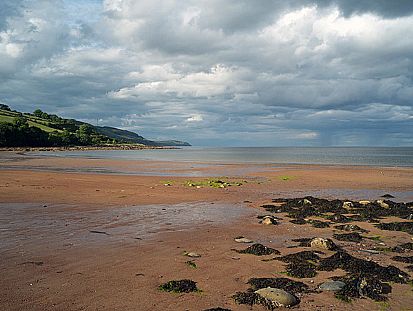
Rosemarkie lies just to the north-east of Fortrose. It nestles in a hollow in the hills, with a beautiful sandy beach in front, and is backed by red sand cliffs which loom over it.
The village is well known for the Pictish stones that have been found there, some fragmentary but some complete, including the Rosemarkie Cross. They are housed in Groam House Museum on the High Street. Before the cathedral was built in Fortrose, Rosemarkie was the local centre of religion, and pilgrims came from all over the country to visit St Boniface’s shrine.
The cliffs and the Fairy Glen
The sand cliffs behind Rosemarkie are favourite nesting sites of fulmars and jackdaws, whose cries form a background to visits in spring. In places the cliff is festooned with creepers and overhanging trees.
Just beyond the cliffs, on the main road, lies the Fairy Glen. This beautiful glen is deeply incised, with the Markie Burn running through it. It is heavily wooded with mostly deciduous trees, especially geans, birches and rowans, which make it spectacularly colourful in autumn. The burn has deep pools, waterfalls and rapids, with a path running beside it along the valley bottom. The glen is an RSPB reserve, best known for buzzards, dippers, grey herons, grey wagtails and song thrushes, with carpets of bluebells in spring.
The glen is a haven for wildlife of all kinds, including the fairies, who, according to superstition, you must greet when you visit. Of great geological interest are the sand pillars found there, formed where a cap of hard rock protects the soft sandy rock beneath it from erosion. Such pillars are extremely rare in Britain.
The beach
Fossils can be found a few miles along the beach to the north. For those not inclined to fossil hunt, the beach still has plenty to offer: it is pretty and secluded, with outcrops of rock where you can sunbathe or picnic and feel you have the shore to yourself. Chanonry Point, one of the best places in Europe to watch dolphins from land, is about a mile’s walk or cycle along the shore.
Rosemarkie is of great historical and geological interest, but it is also a picturesque and peaceful little village that anyone would enjoy visiting.