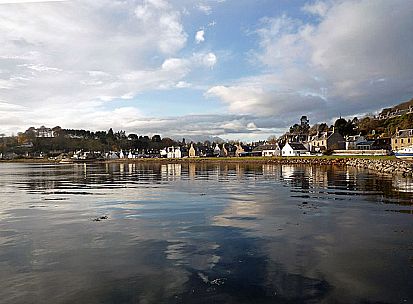
On the A832 on the south coast of the Black Isle lies Avoch, a conservation village steeped in history. It is pronounced “Auch”: the v is always silent.
A fishing village
Avoch is famed for its long fishing heritage. Fishing for herring and sprats in the Inverness and Beauly Firths supported the village for more than a hundred years. The waters are now protected and the Kessock herring are no longer harvested commercially, but Avoch still has a small modern fleet working much further afield. As a fishing community in an area dominated by farming, Avoch developed its own dialect.
You can still walk around the old town, including the Dock, named by fishermen who drew their boats up on the beach before the harbour was built. The narrow “streeties” running at right angles to the shore bear the family names of the Mackenzie lairds of Avoch, and just across the burn mouth, Henrietta Street has a row of low, white-walled fisher cottages.
The harbour, at the eastern end of the fishertown, was built in 1815 to a design by Thomas Telford and extended in 1903 for a growing fleet. The Avoch Harbour Trust, formed the same year, still manages it, and pontoons now serve local and visiting yachts. Look out from the harbour for common terns, which nest on rafts in the bay in spring and early summer; under RSPB management the colony has grown into one of the most important in Scotland.
Ormond Castle
West of Avoch, forming a headland, is Ormond Hill, also called Ladyhill, the site of Ormond Castle. Built around 1197, it was once the home of Andrew de Moray, who led the first Scottish War of Independence against Edward I alongside William Wallace. It is a scheduled ancient monument, and the walk up gives excellent views over the bay.
Rosehaugh
The Rosehaugh estate on the edge of Avoch was once one of the most splendid in the area. From 1864 James Fletcher turned the house into a virtual palace, with turrets, balconies, a huge blue dome and a heated indoor pool, and filled the grounds with lakes, a racecourse, an orangery and a mile of ornate glasshouses. After Lilian Fletcher died without heirs in 1953, the house was sold and demolished; only a stone stairway down to the former gardens remains. The grounds, and some of the other buildings, are still there, with excellent walks through mature woodland and stunning views.
Avoch is full of character and well worth a visit. As well as Ormond Hill and Rosehaugh, there is a pretty walk and cycle along the old railway line to Fortrose.